Update (2010-02-25): This contest is now closed.
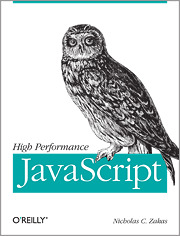
Last year, Yahoo! engineer and all-around JavaScript badass Nicholas Zakas asked if I was interested in writing a chapter for a new book on JavaScript performance that he was working on. I agreed, and that book, High Performance JavaScript, is now available for preorder at Amazon and other fine book retailers.
In addition to the wide-ranging content by Nicholas and a chapter on string and regular expression performance by yours truly, chapters were also contributed by an awesome lineup of JavaScript performance gurus: Ross Harmes, Julien Lecomte, Stoyan Stefanov, and Matt Sweeney. This book is unique in its laser-focus on optimizing the performance of your JavaScript applications, and covers many advanced topics in the process. The chapter on strings and regular expressions provides what I think is easily the most in-depth coverage of cross-browser JavaScript regex performance currently available.
Here's the list of chapters:
- Loading and Execution
- Data Access
- DOM Scripting (Stoyan Stefanov)
- Algorithms and Flow Control
- Strings and Regular Expressions (Steven Levithan)
- Responsive Interfaces
- Ajax (Ross Harmes)
- Programming Practices
- Build and Deployment (Julien Lecomte)
- Tools (Matt Sweeney)
To celebrate the completion of this book, I'm giving away three copies. O'Reilly Media increased the offer to five books! All you need to do is comment on this post by February 24th, and I'll pick five people to send a copy to as soon as it's released (Amazon says March 15th). If you prefer, I'd be happy to send you a copy of Regular Expressions Cookbook instead (please note which book you want in your comment). Four winners will be chosen at random from the pool of unique commenters (I'll be tracking IPs), and the fifth based on the reason given for why you want a copy.
Make sure to include your email address in the comment form, since I'll need it to contact you if you're selected (your email address won't be used for any other purpose). Good luck, and congratulations to Nicholas Zakas and all the other authors on completing a fantastic new book!
Edit (2010-02-05): My blog has been offline more often than not for the first two days after posting this, and many people have reported that they were unable to post a comment. I apologize for the screw-up—my blog is now on a different server, and the problems should be resolved. Please try again!
Edit (2010-02-08): O'Reilly Media kindly offered to pick up the tab for this giveaway, and increased the winnings to five books!
Edit (2010-02-09): Nicholas Zakas posted more information about High Performance JavaScript on his blog: Announcing High Performance JavaScript.
Edit (2010-02-25): This contest is now closed. Winners will be announced here shortly.
Edit (2010-03-03): Following are the winners of this giveaway (the first four were chosen randomly):
No. 5 Adam Crabtree, who wants to review the book and share it with members of the DallasJS Meetup Group, wins the nonrandom drawing for the best reason to win a copy. Runners up for this selection were Yoav, who promised to donate the book to a high school library after he's done with it; Nick Carter, who threatened me with his wrath if he doesn't win (I'll have to endure); Paul Irish, who kindly offered to have my last name corrected (to that of a sea monster) in exchange for winning; Alexei, a technical editor of a couple of Nicholas Zakas's previous books who'd like to know how many errors this one contains; and Marcel Korpel, who wants to improve his users' health by reducing the "headaches, general stress and insomnia" they suffer while waiting on his websites. 🙂
The winners have been informed by email about how to collect their prize. Thanks to everyone for playing!
